19 Small Laundry Room Ideas That Maximize Every Inch

When the laundry room is barely bigger than a closet, every centimetre has to earn its place. The best small laundry room ideas don’t try to squeeze a big-room layout into a tiny footprint — they build upward, hide storage in forgotten gaps, and choose machines and doors that give floor space back.
These 19 ideas are made for compact dedicated rooms and laundry closets, where a stacked pair, a shelf in the right gap, or a door that stops swinging can double what the room holds. Pick the two or three that solve your biggest bottleneck first — in a small room, one smart change usually unlocks the next.
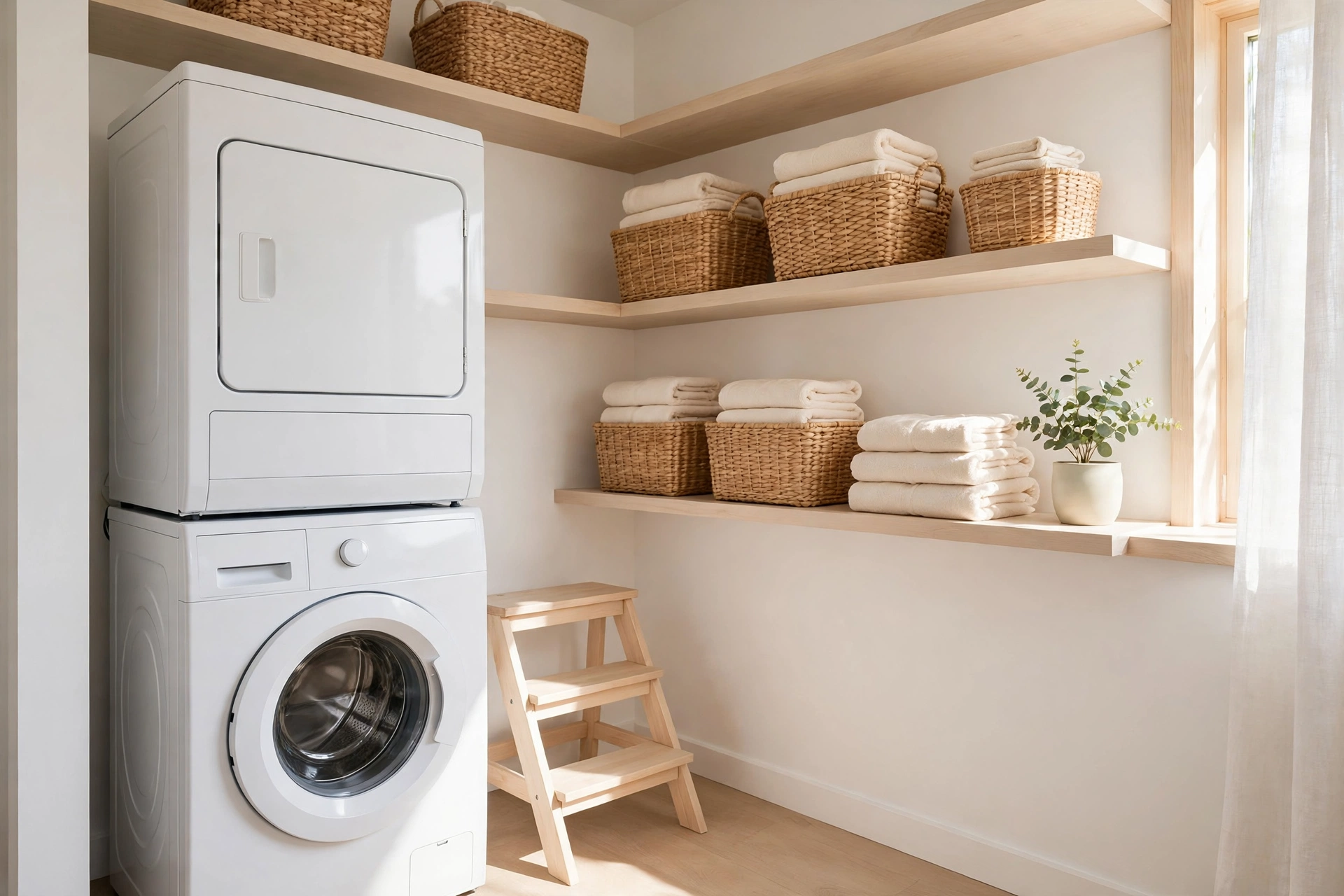
1. Stack the Washer and Dryer to Halve the Footprint
A stacking kit lets a front-load washer and dryer share one footprint, freeing an entire machine-width of floor for shelving, a hamper, or simply room to move. It is the single biggest space-save in a small laundry room, and modern stacking kits lock the pair together so the dryer stays put through every spin cycle. Most pairs put the dryer controls around chest height, which suits most adults comfortably.
Tip: Measure your ceiling height before ordering — a stacked pair typically needs around 2 metres of clear height, plus a little extra for hoses and vents.
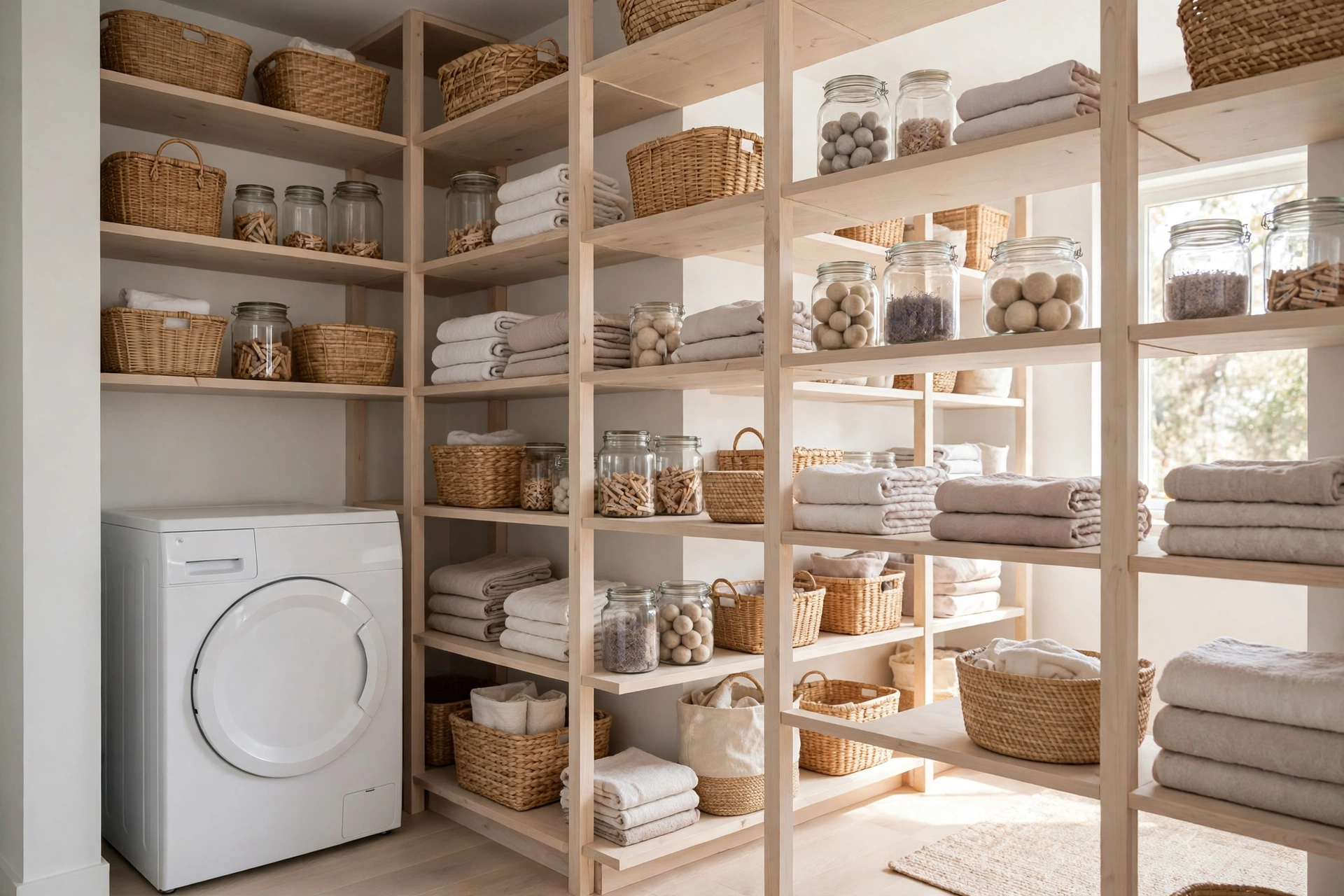
2. Take Shelving From Floor to Ceiling
Walls are the one surface a small laundry room has plenty of, so run open shelving all the way up instead of stopping at eye level. Everyday detergents live on the low shelves, while bulk refills, spare linens and rarely used supplies go up top, out of the way but still in the room. Open shelves also keep everything visible, which stops the buy-it-twice clutter that eats small spaces.
Tip: Keep shelf depth to about 30 cm so items never disappear behind each other in a dark second row.
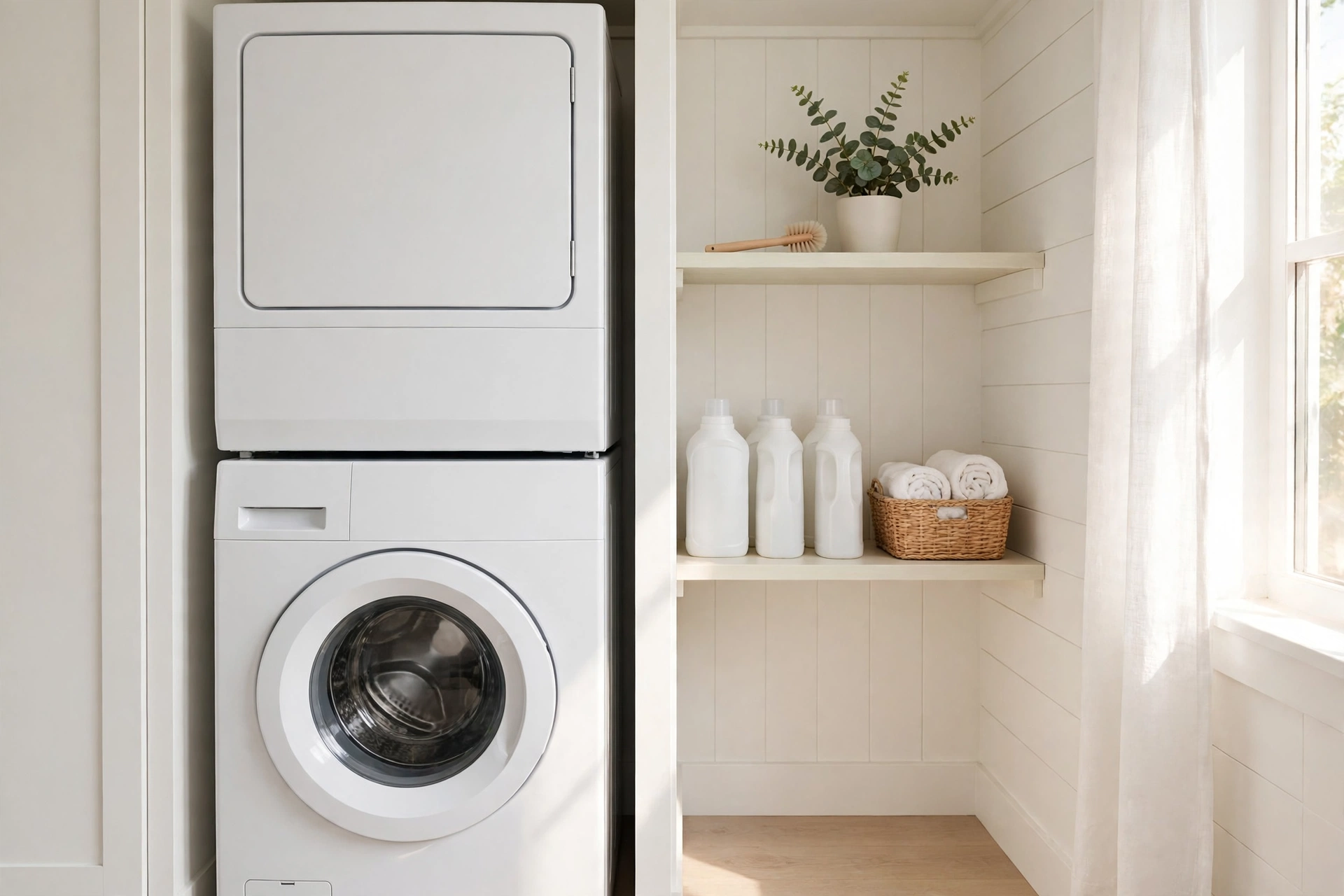
3. Bridge a Shelf Directly Over the Machines
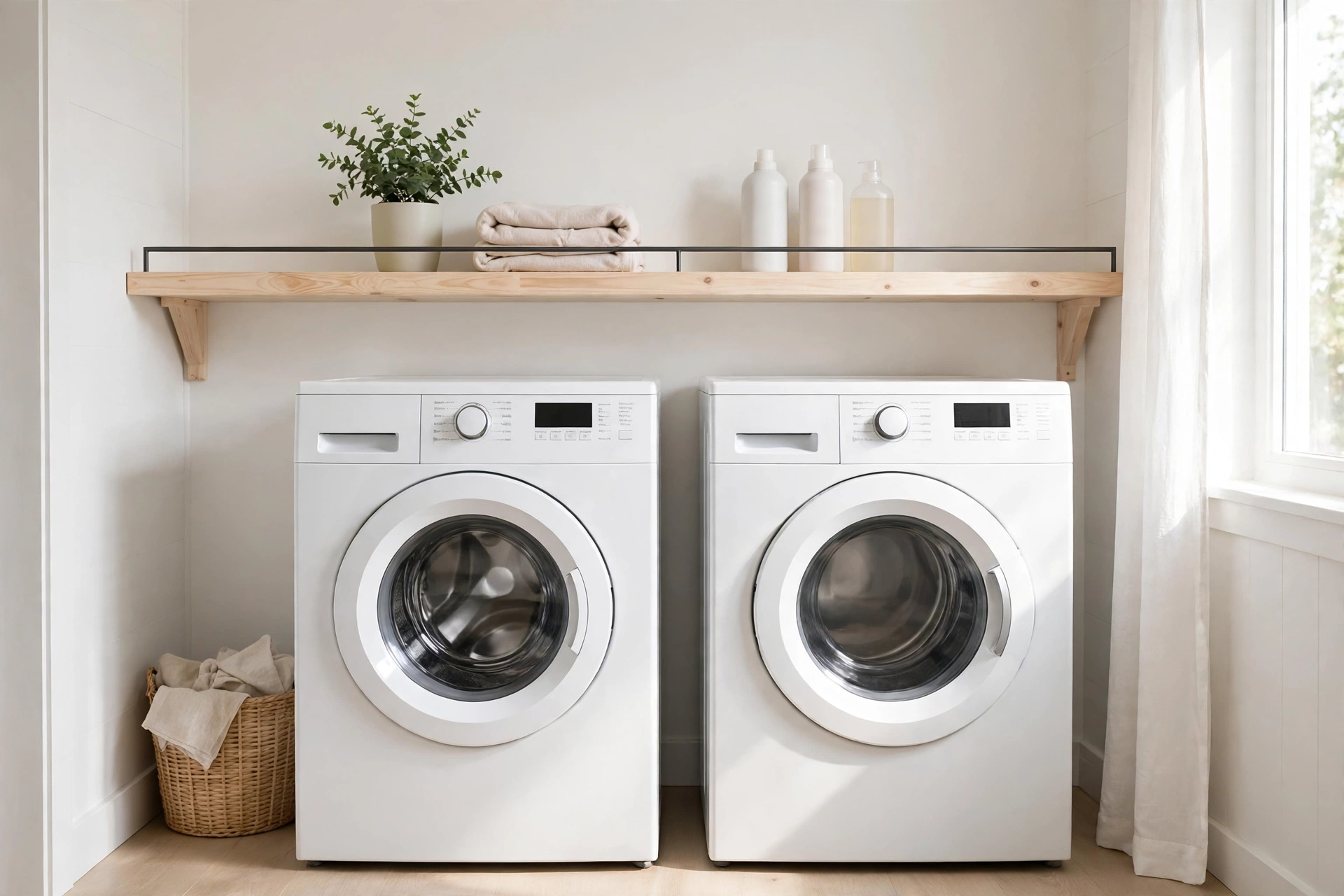
The strip of wall right above a washer and dryer is usually wasted, yet it is the most convenient storage spot in the room. A single shelf or a pair of wall cabinets there keeps detergent, stain remover and dryer sheets exactly where you use them. If the machines are stacked, one longer shelf along the side wall does the same job.
Tip: Add a small rail or lip to the shelf edge so bottles can’t vibrate off during a spin cycle.
4. Fold Down a Wall-Mounted Drying Rack
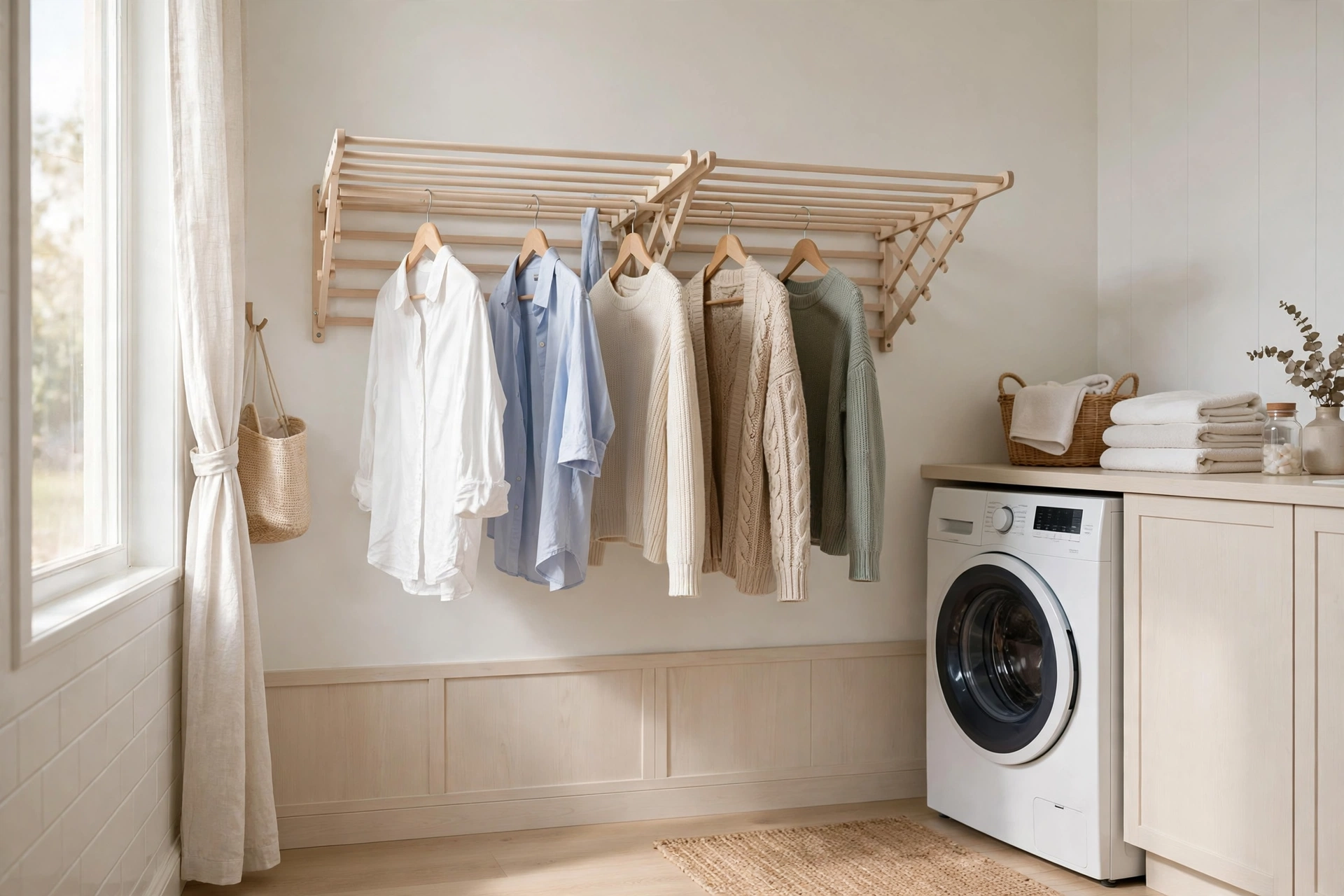
Delicates need air-drying space that a small room simply doesn’t have on the floor. A wall-mounted rack folds down when you need it — holding shirts, knitwear and gym gear on hangers or flat — then folds away against the wall when you don’t. Accordion and tilt-down styles both work; mount it beside the machines or over a sink where drips don’t matter.
Tip: Fix the rack into wall studs or use proper hollow-wall anchors — a rack full of wet laundry is heavier than it looks.
5. Swap the Swinging Door for a Pocket Door
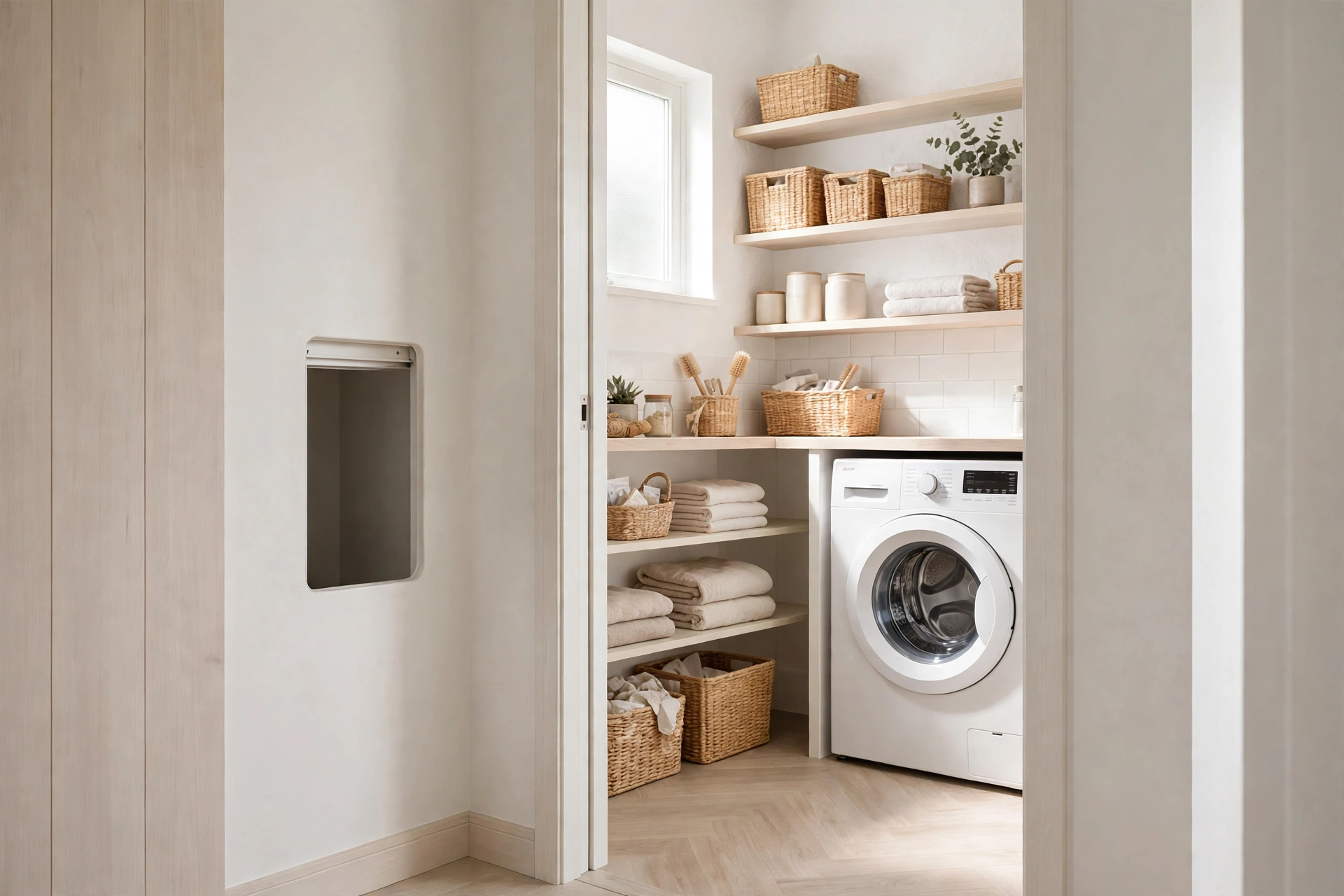
A standard hinged door swings through almost a square metre of floor — space a small laundry room can’t spare, and the reason the wall behind the door is always dead. A pocket door slides into the wall itself, freeing that whole arc for shelving, a hamper, or the folding surface you actually need. If rebuilding the wall isn’t an option, a surface-mounted sliding door on a rail gives most of the same benefit with far less work.
Tip: Check what’s inside the wall before planning a pocket door — plumbing and wiring runs may need rerouting first.
6. Hang Supplies on the Back of the Door
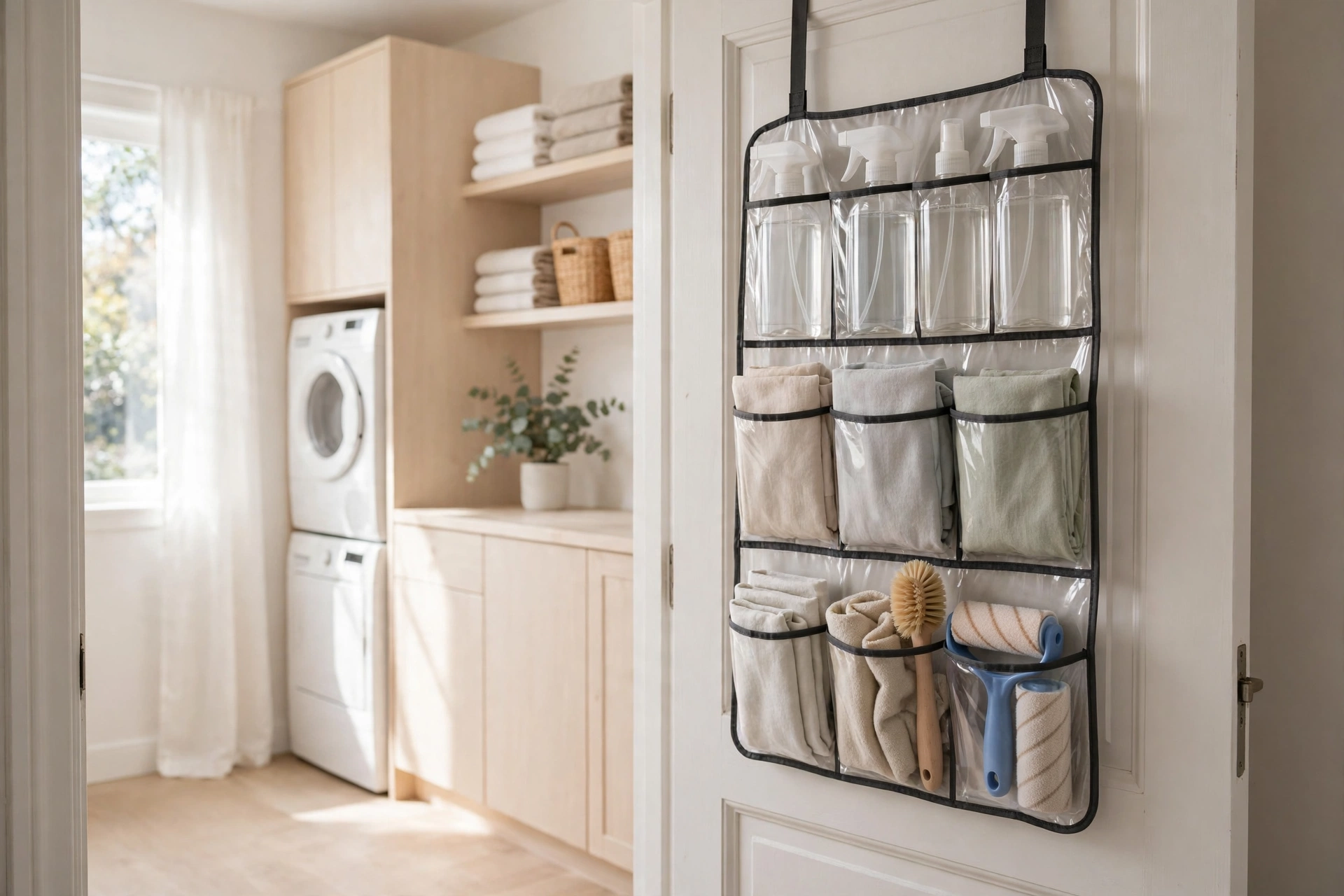
Whatever door your room has, its back face is free storage. A clear-pocket over-door organiser holds stain sticks, lint rollers, sewing kits and spare cloths in plain sight, while a couple of hooks take a mesh wash bag or the ironing supplies. It adds a whole cabinet’s worth of small-item storage without touching a wall.
Tip: Choose an organiser with hooks sized to your door thickness so it doesn’t rattle or stop the door closing fully.
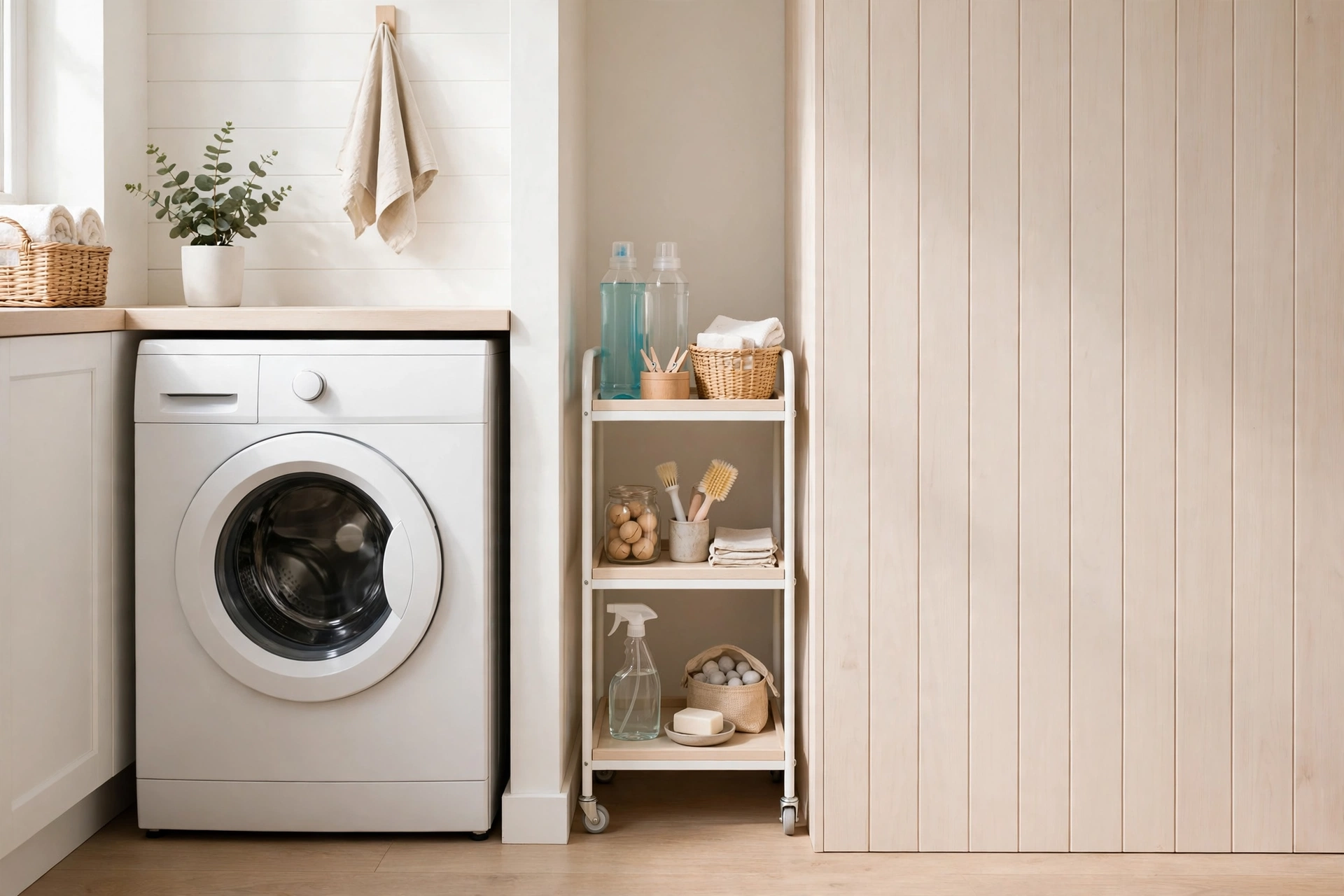
7. Slide a Slim Cart Into the Wasted Gap
Between two machines, or between a machine and the wall, there is almost always a 10–15 cm gap doing nothing. A slim rolling cart sized to that gap stores detergent bottles, dryer balls and cleaning sprays in tiers, then rolls out when you need something and disappears again. It’s the cheapest square footage you’ll ever add to the room.
Tip: Measure the gap at its narrowest point — skirting boards and hoses often steal a centimetre or two.
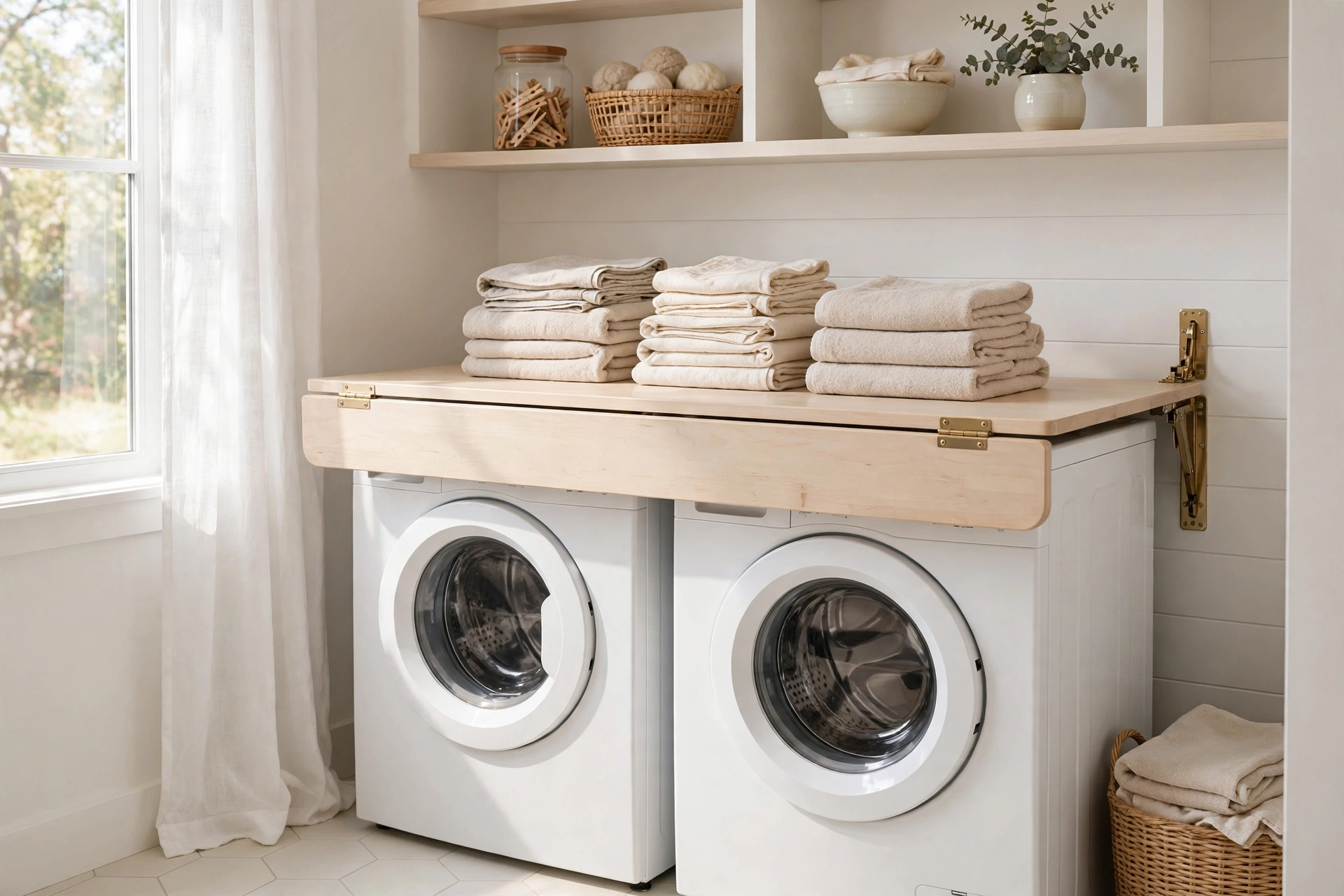
8. Mount a Folding Table That Disappears
Folding laundry straight from the dryer stops it migrating to the sofa, but a small room has no floor for a table. A wall-mounted drop-leaf table gives you a proper folding surface at standing height, then folds down flat — some models leave just a slim cabinet profile on the wall. Beside the machines is the classic spot if that wall is free.
Tip: Position the table so the folded leaf never blocks a machine door or the rack when it’s down.
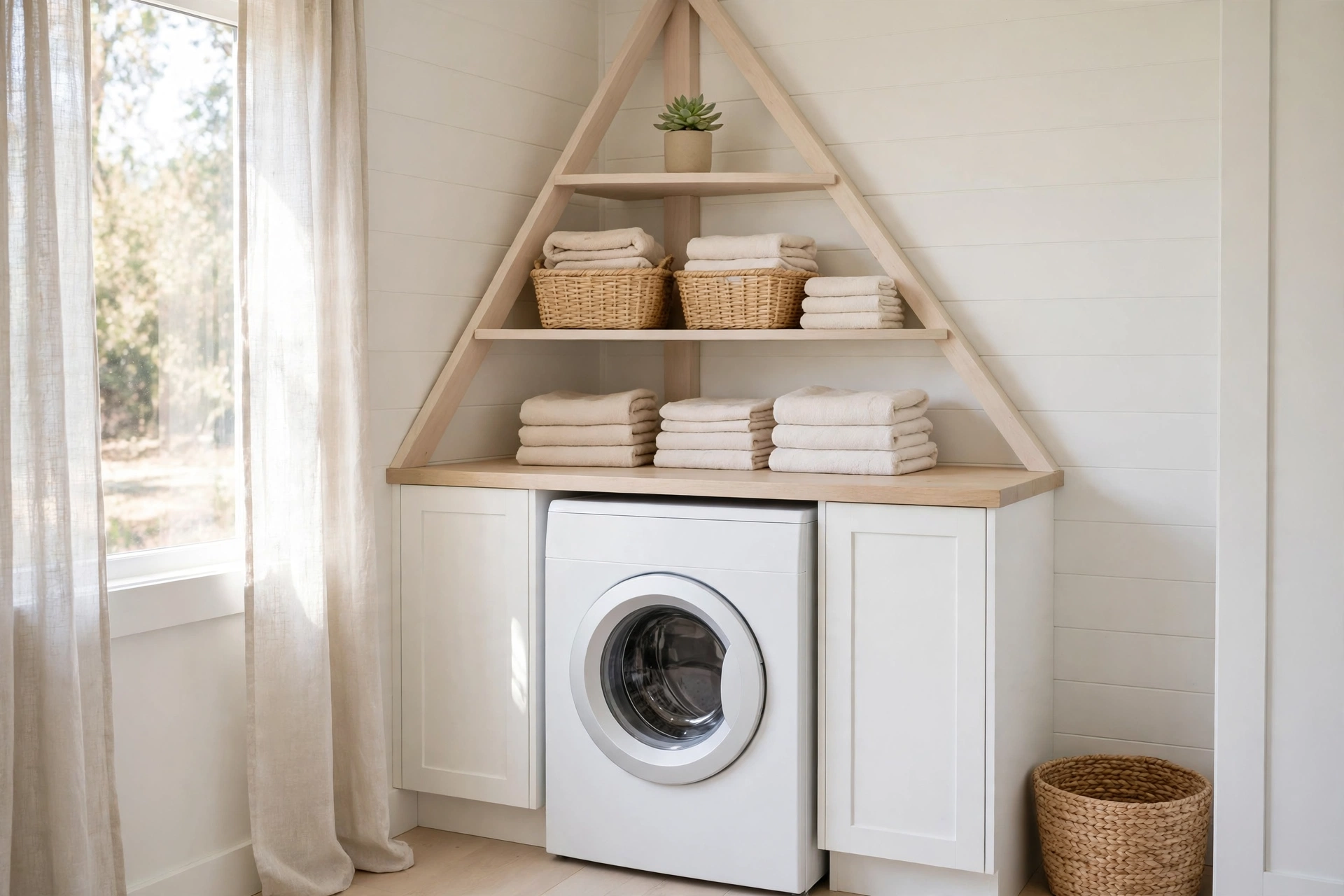
9. Put the Corner to Work With Shelves
Corners in small rooms collect dust and lost socks because standard shelves don’t fit them. Corner shelves — triangular, quarter-round, or a slim tower — turn that dead angle into storage for folded towels, plants, or the pretty baskets that hide the ugly bottles. Even one corner shelf at head height can clear a whole worktop’s worth of clutter.
Tip: Use the corner for lighter, prettier items — it keeps the room feeling open instead of boxed in.
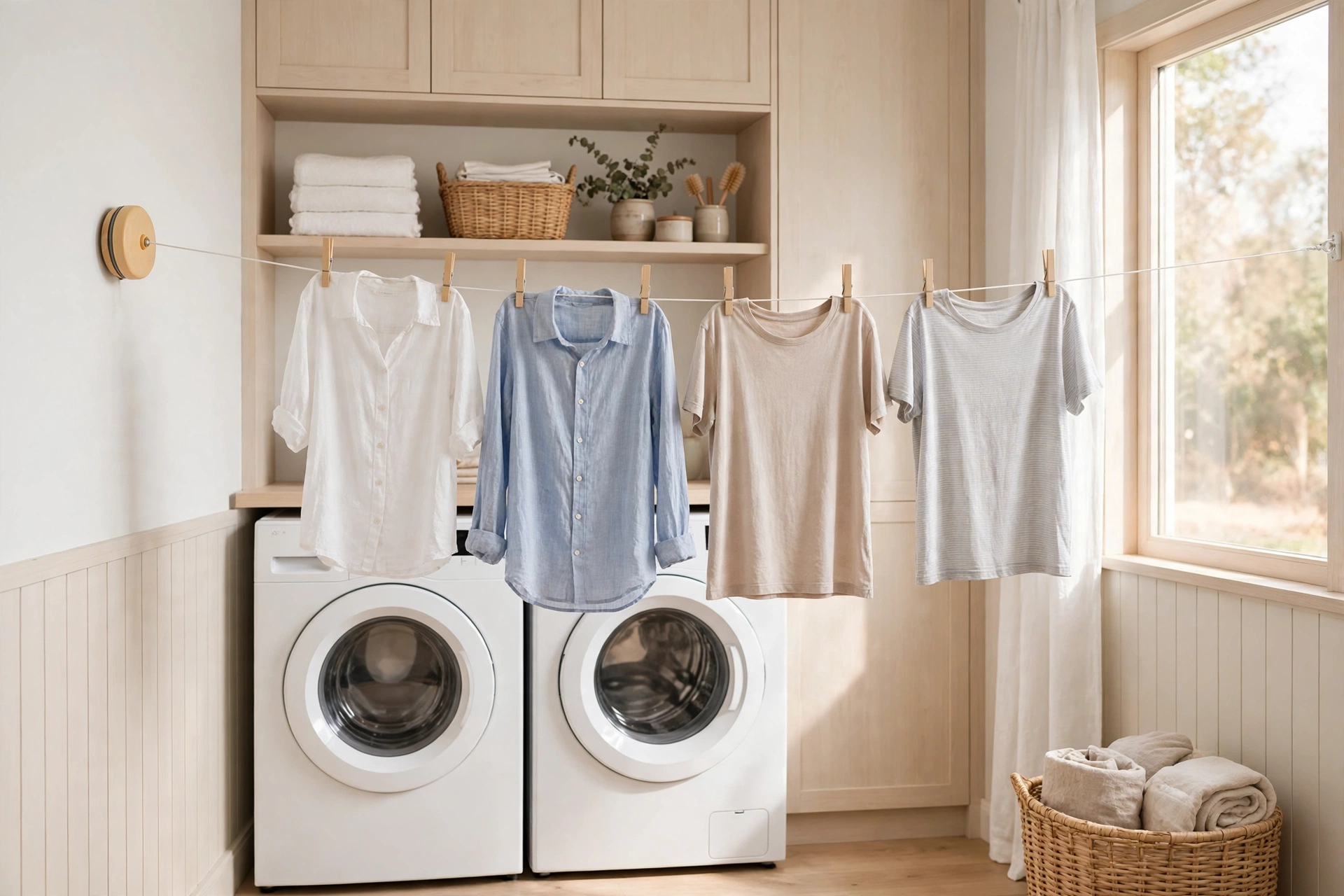
10. String a Retractable Clothesline Across the Room
A retractable clothesline pulls across the room when the wash is done and winds itself away into a small wall casing afterwards. Stretch it over the machines or across a corner and it air-dries a full load of shirts without a rack eating the floor. Hotel-bathroom style lines are inexpensive and rated for surprisingly heavy loads.
Tip: Mount the line high enough to walk under, and angle it so drips fall over the machines or a sink, not the walkway.
11. Size Bins and Baskets to Your Shelf Depth
Random containers waste space twice — once in the gaps around them, once in the dead air behind them. Choose bins and baskets that match your shelf depth and width so they tile together edge to edge, and use the same family throughout so shapes and lids stack neatly. Label the front of each one and a small room starts to run like a well-organised stockroom.
Tip: Leave one bin deliberately half-empty — it becomes the landing spot for odd items instead of the floor.
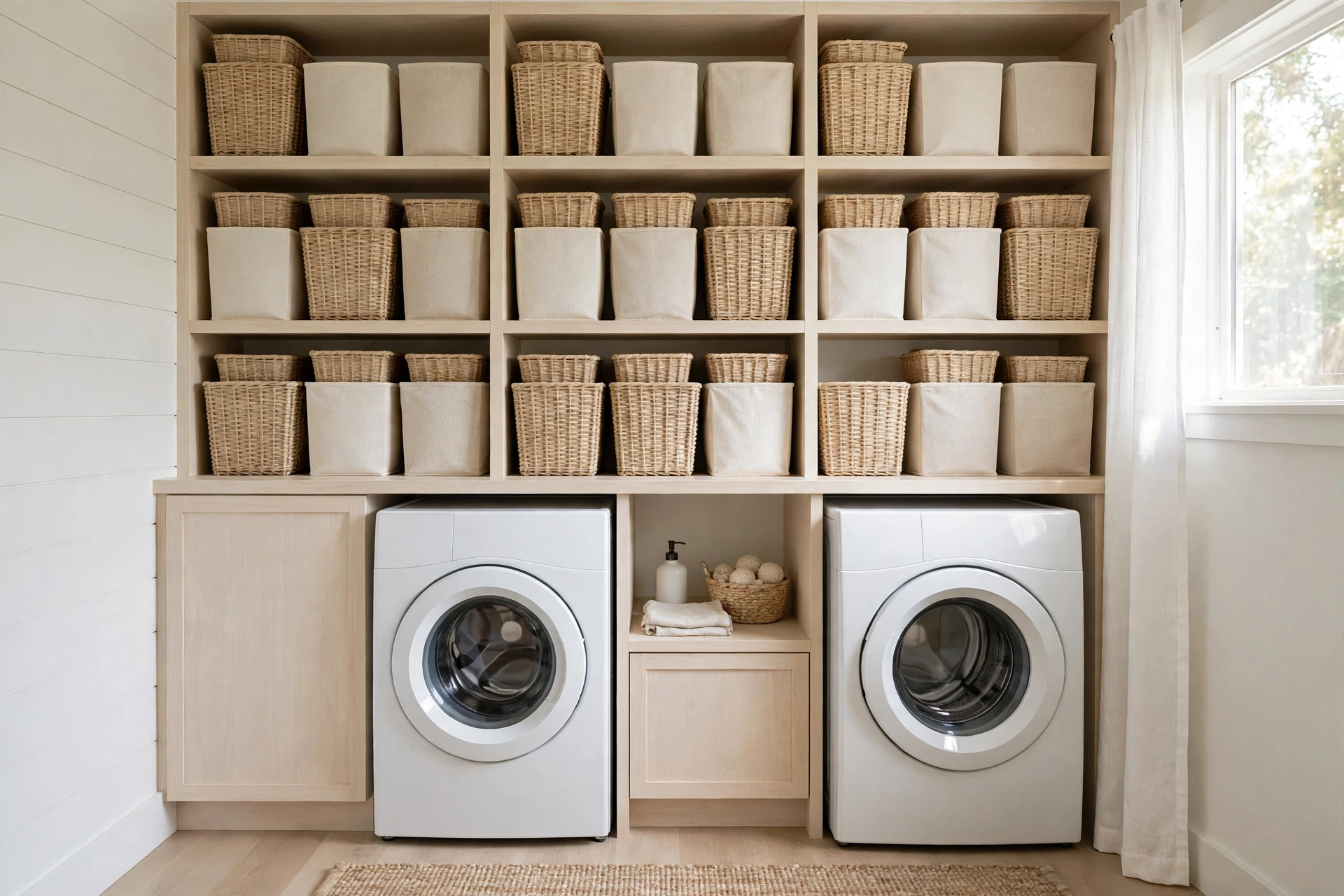
12. Paint It Light to Make It Feel Bigger
Colour can’t add centimetres, but it can remove the cave feeling that makes a small laundry room unpleasant to be in. White, soft cream or pale grey walls bounce light into corners, and a satin or semi-gloss finish reflects even more while shrugging off splashes. Keep the machines, walls and shelves in one light family and the room reads as a single calm space instead of a jumble of boxes.
Tip: Paint the ceiling the same light colour as the walls — the unbroken wrap makes the room feel noticeably taller.
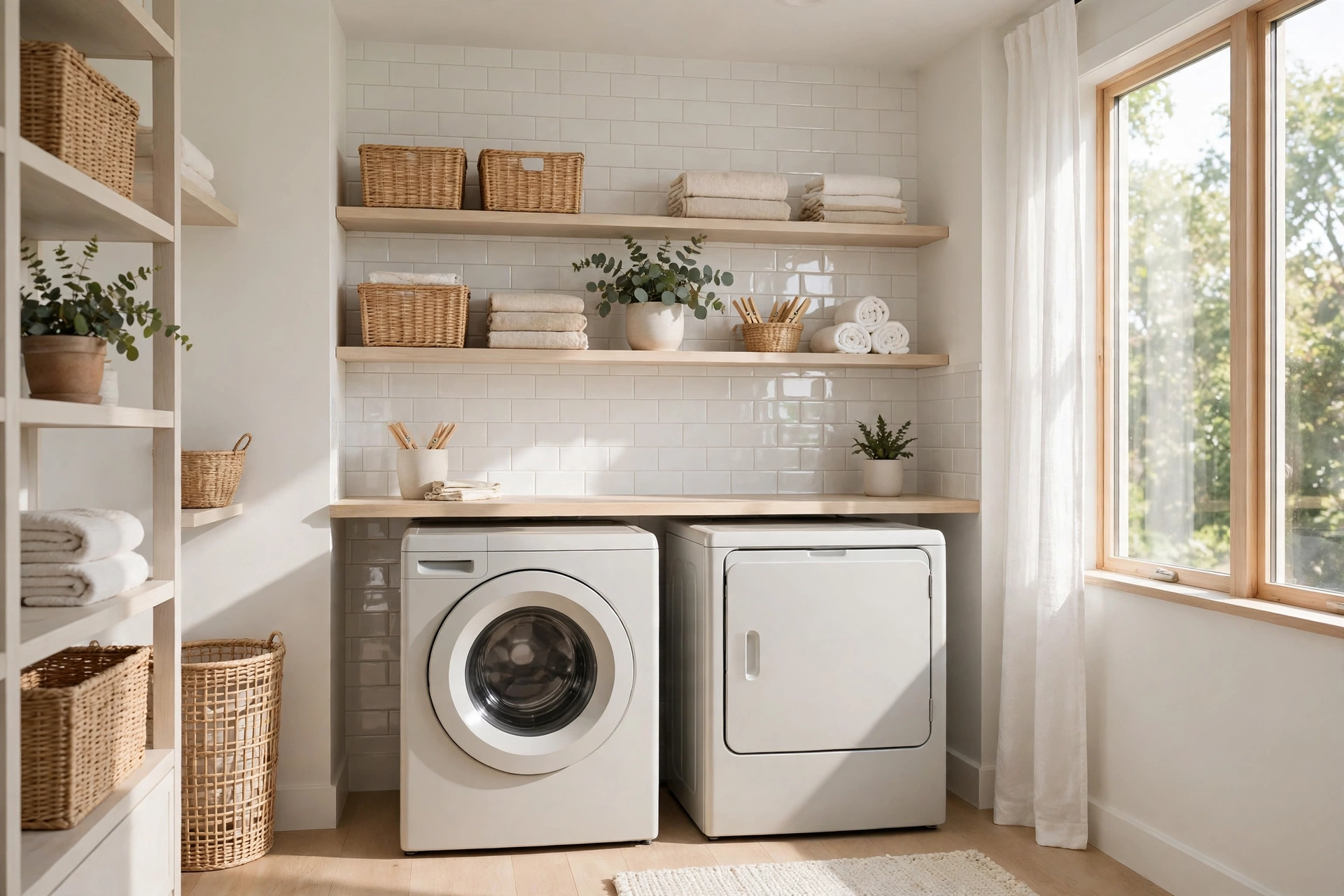
13. Add a Hanging Rail Under a Shelf
Shirts crease less if they go on hangers straight out of the wash, but small rooms have no garment rack. A short rail or tension rod mounted under a wall shelf or cabinet gives you a row of hanging space exactly where you fold and sort. It doubles as air-drying space for a few delicates on busy wash days.
Tip: Keep a small stash of hangers on the rail itself so they’re always within reach mid-load.
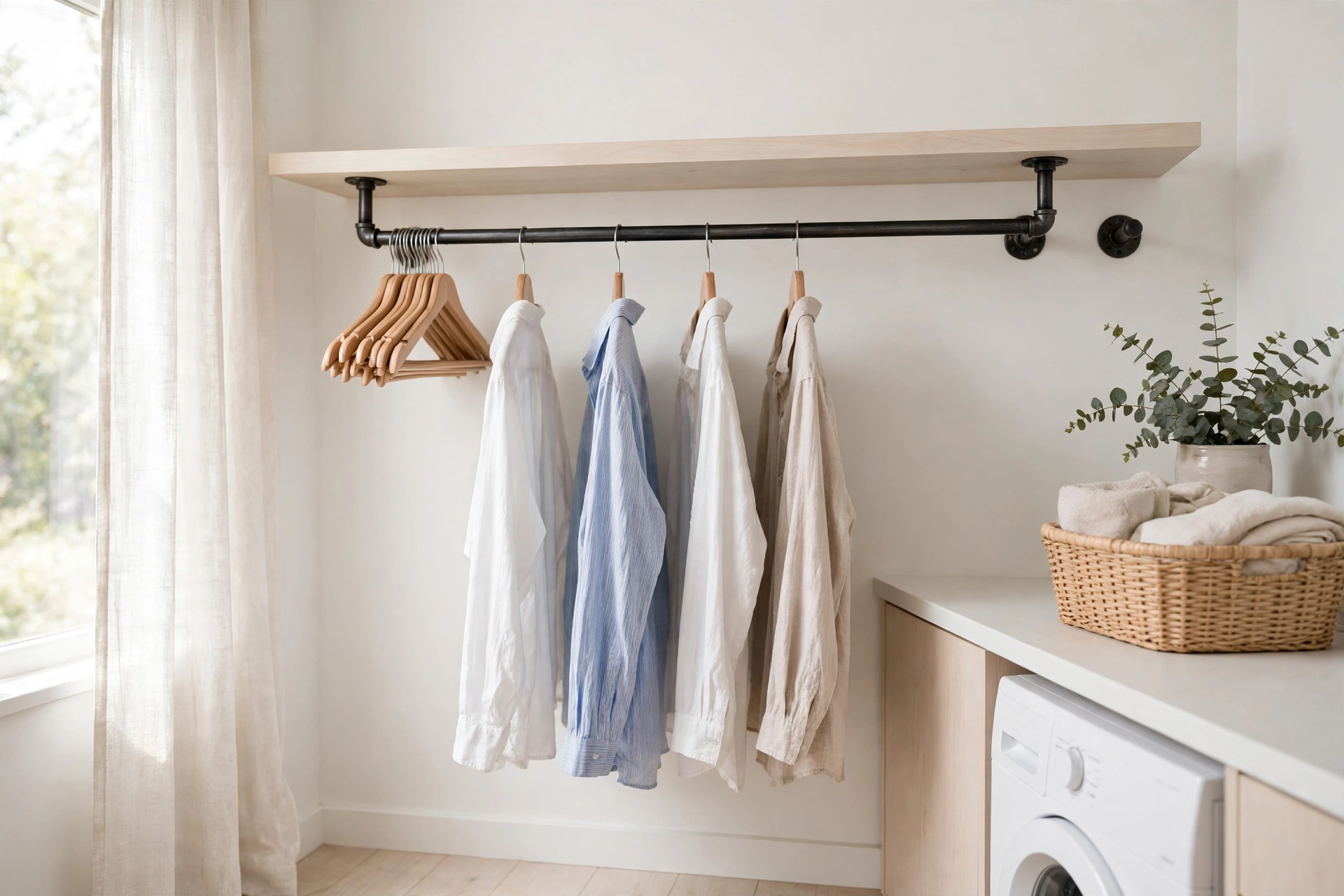
14. Steal the Strip of Wall Above the Door
The band of wall between the door frame and the ceiling is the most forgotten storage spot in any small room. One shelf up there holds the things you need twice a year — the big detergent refill, spare bulbs, the rarely used iron — safely out of the daily traffic. Because it sits high and outside normal sightlines, the room still feels uncluttered.
Tip: Store high-shelf items in one handled basket so you can lift the whole lot down in one go.
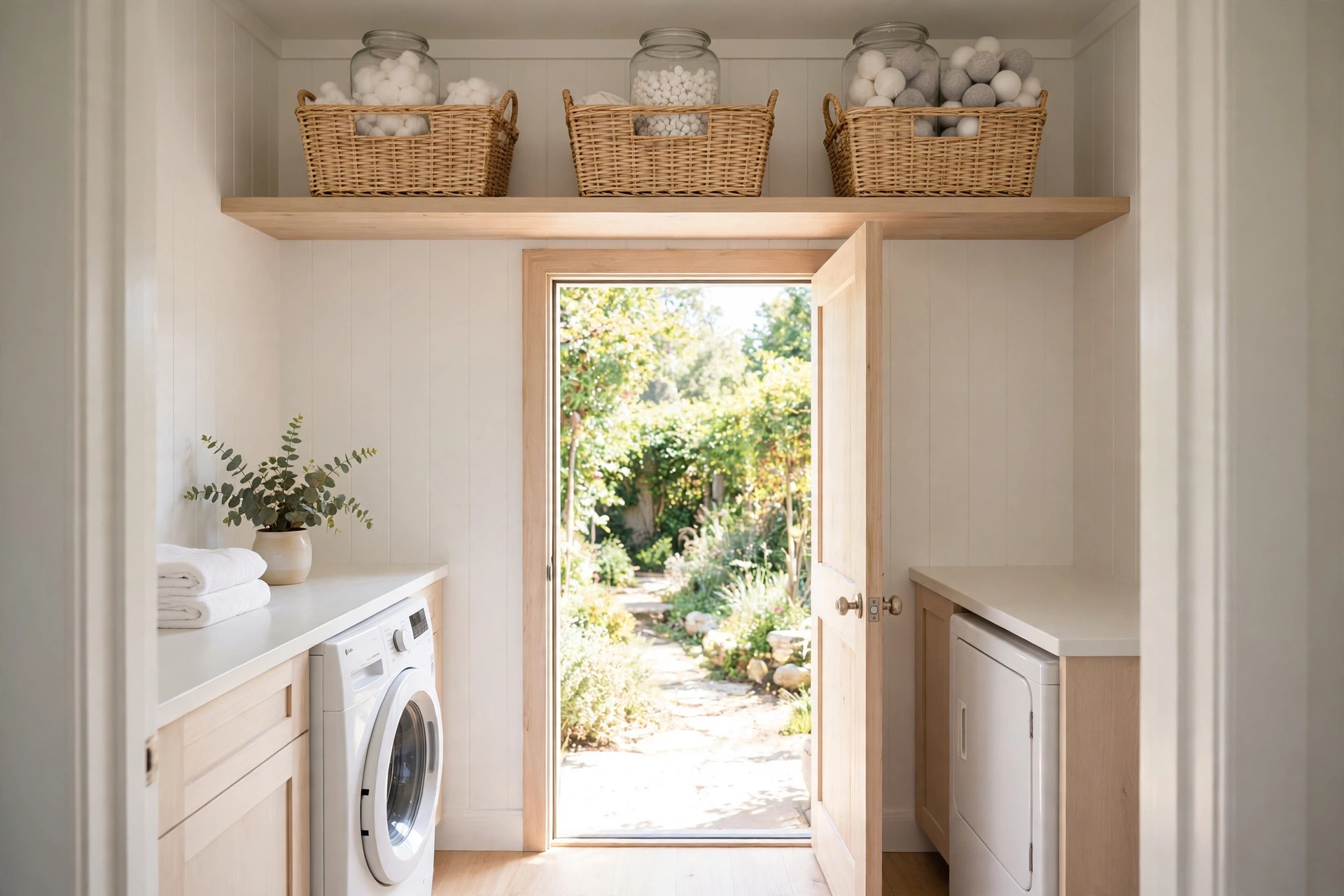
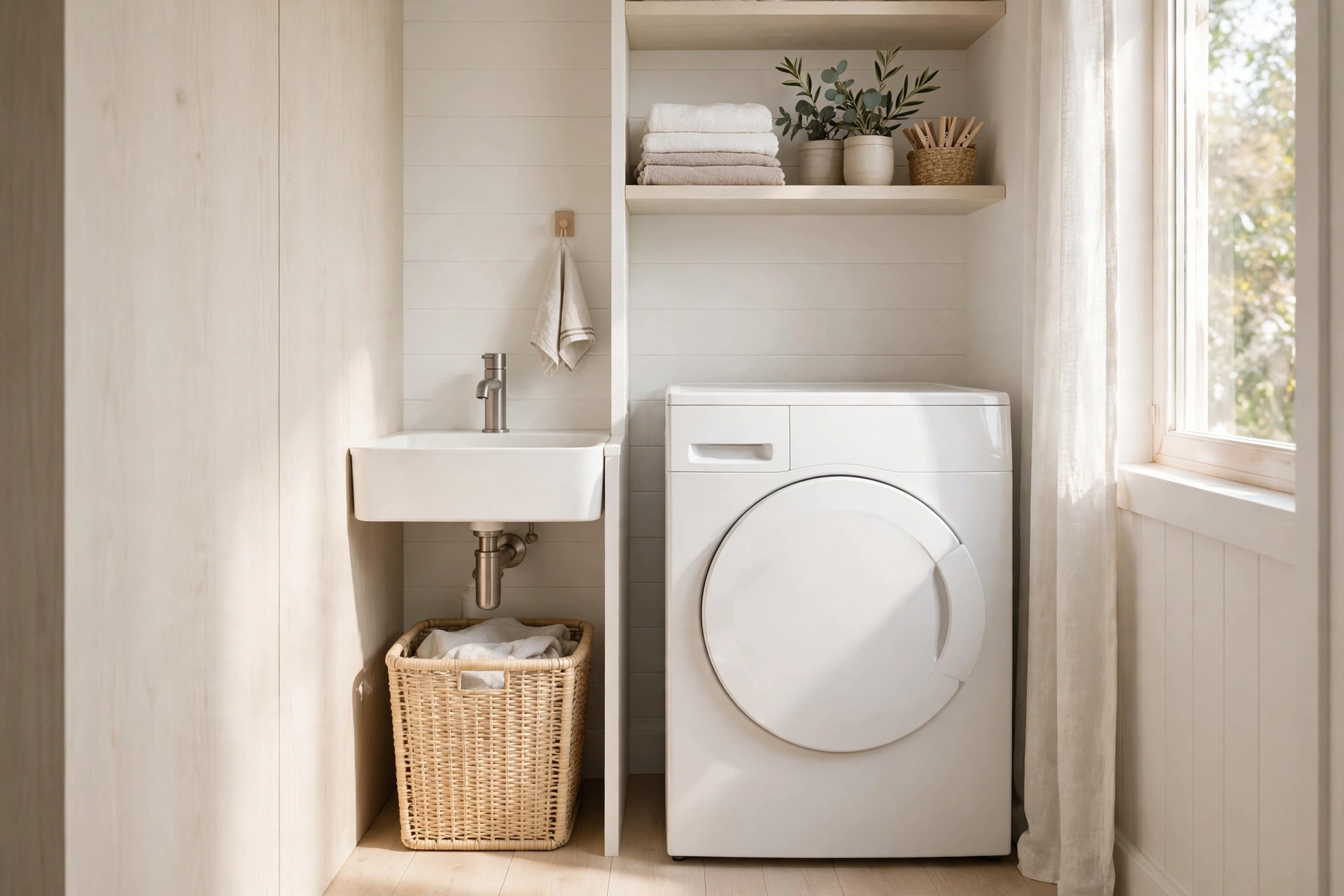
15. Choose a Slimline Sink — or Skip It Entirely
A standard utility sink can swallow a quarter of a small laundry room’s floor. A slimline model — narrower and shallower — keeps the soaking and hand-washing function at half the footprint, and wall-hung versions free the floor beneath for a hamper or the step stool. And if you rarely hand-wash, deleting the sink altogether for a longer shelf run may serve you better.
Tip: If you keep a sink, choose one with a flat cover board so it can double as folding space.
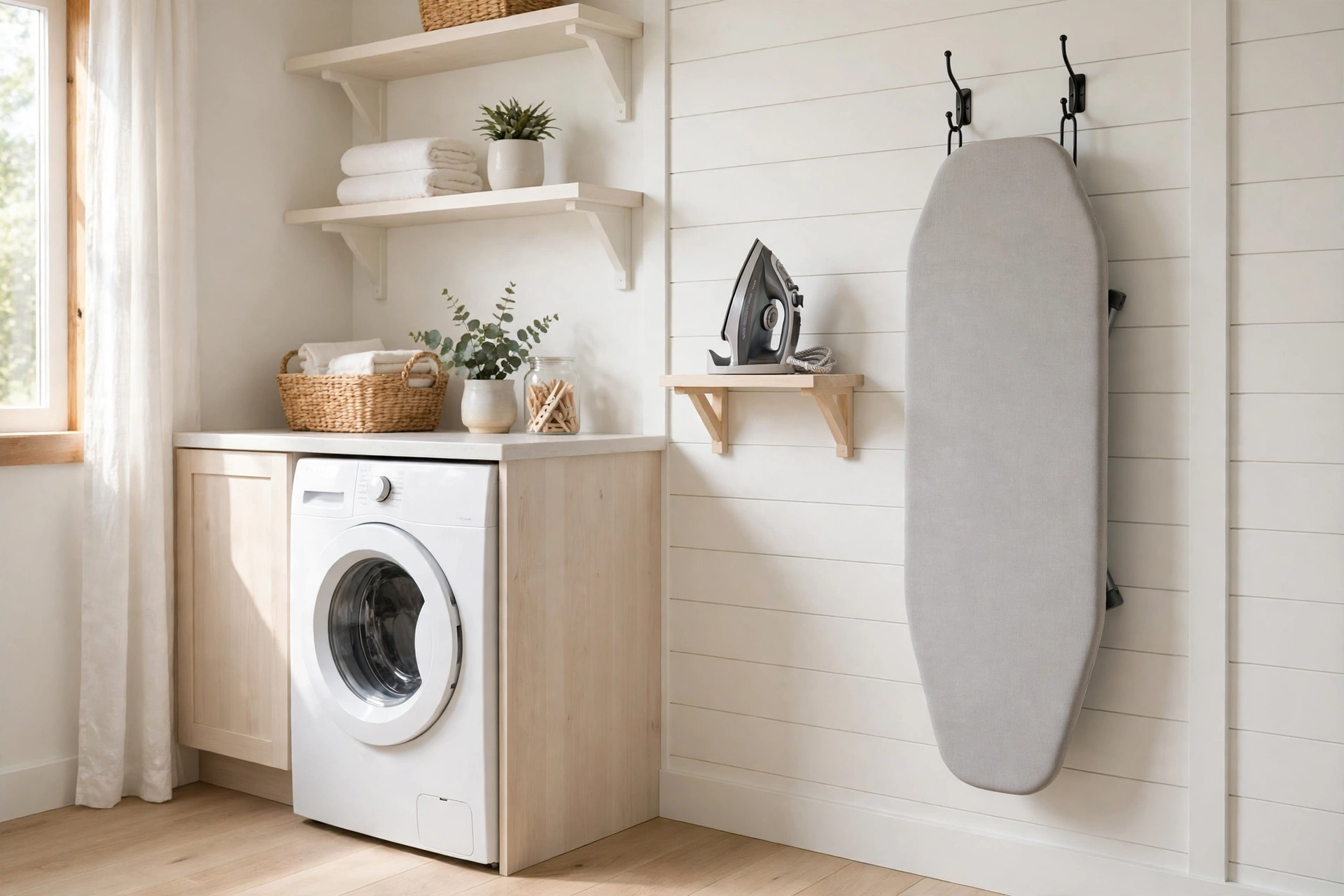
16. Store the Ironing Board Flat Against the Wall
An ironing board leaning in a corner is a small room’s trip hazard and space thief. Two hooks or a purpose-made holder mount it flat against a wall or inside a tall cupboard, where it takes up barely five centimetres of depth. Some holders add a small shelf for the iron itself, keeping the whole ironing kit in one flat package.
Tip: Mount the board near where you iron — if it’s a chore to fetch, it will end up living in the corner again.
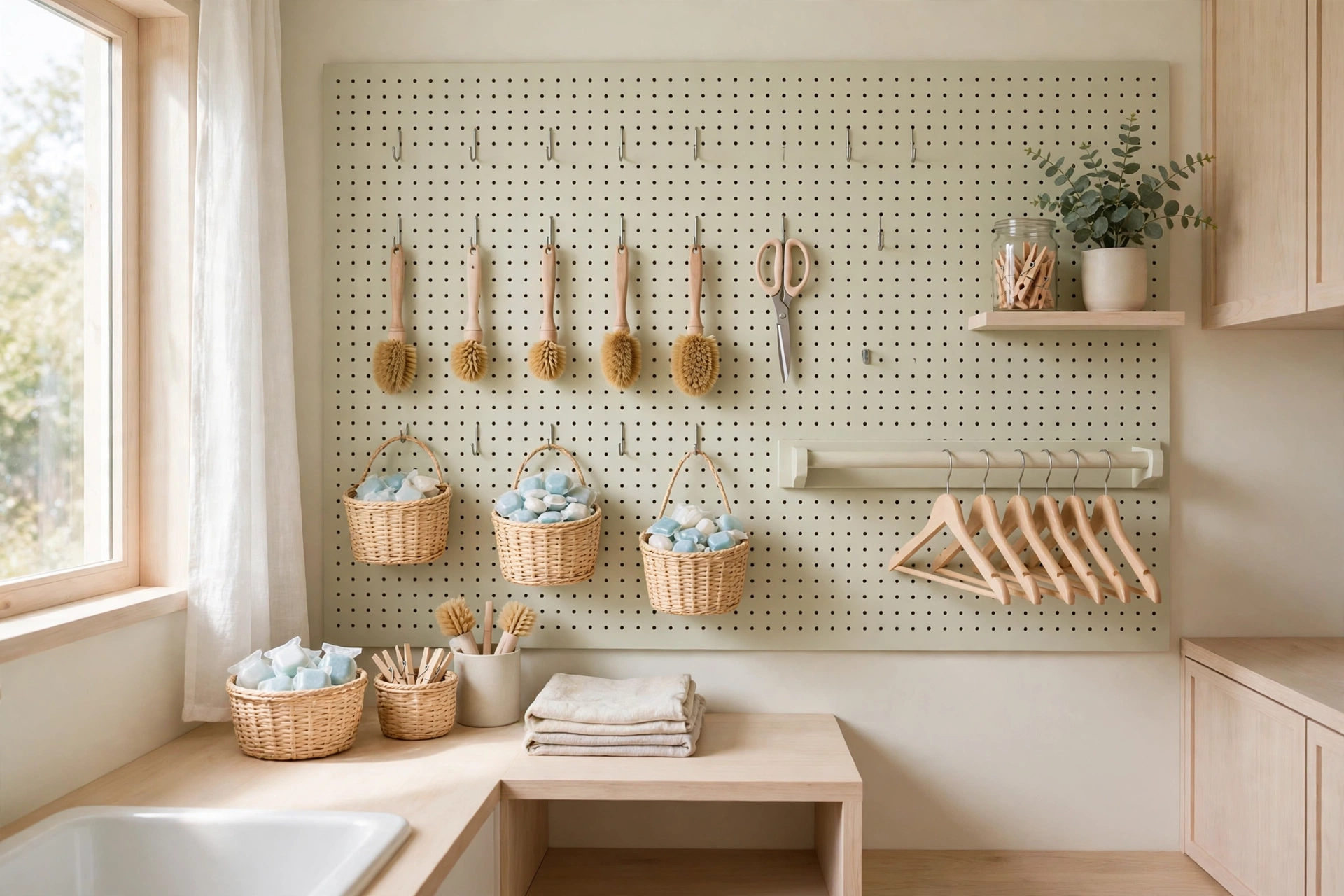
17. Cover One Wall With Pegboard Storage
Pegboard turns a flat wall into storage you can rearrange as your needs change — hooks for brushes and scissors, small baskets for pods and pegs, a short rail for the lint roller. In a small laundry room it keeps a dozen little essentials off the shelves and worktops, each in a visible, grabbable spot. Paint it the wall colour and it reads as intentional design rather than workshop.
Tip: Mark each item’s spot with a faint pencil outline — the board stays tidy when everything has a home to return to.
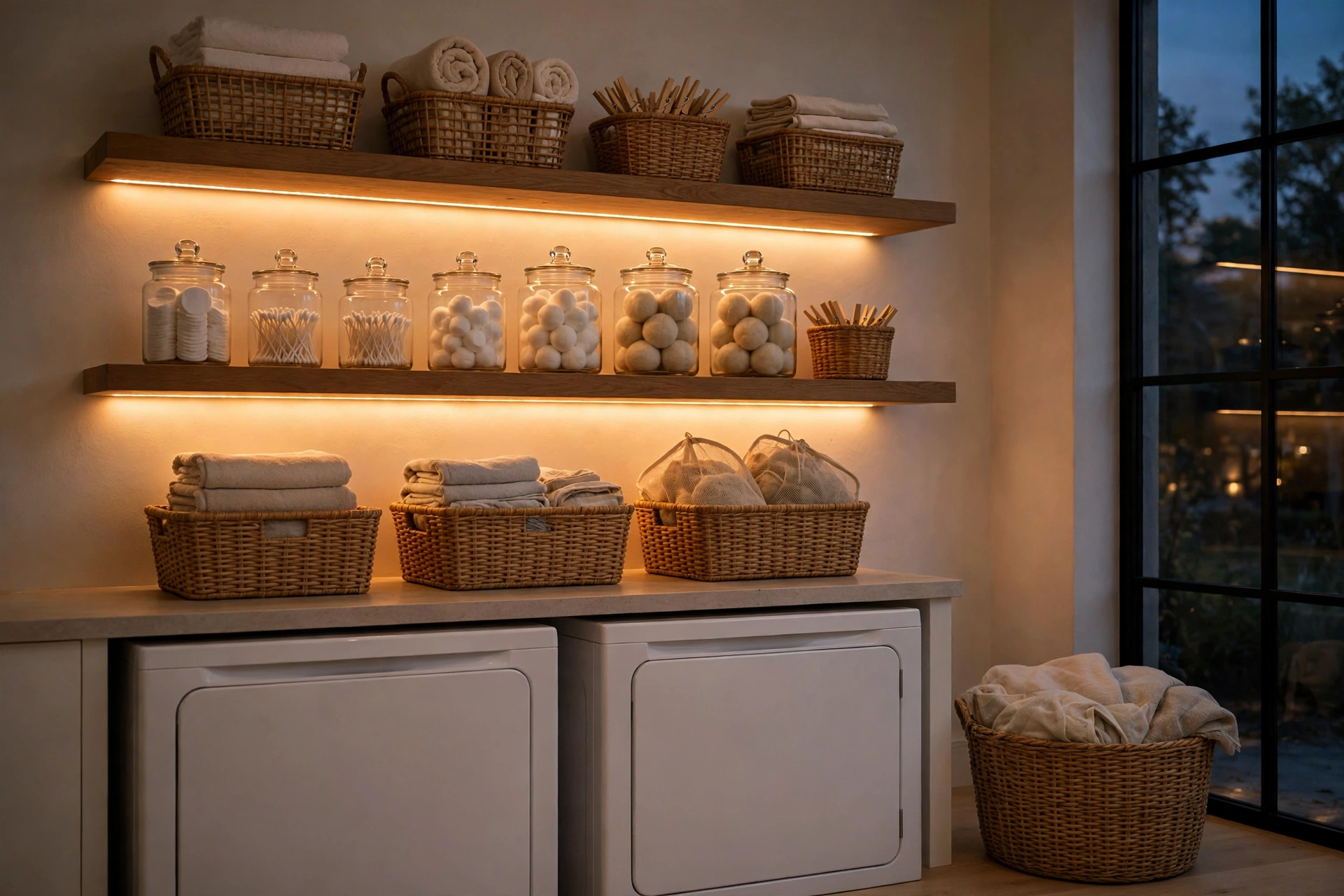
18. Light Every Shelf With LED Strips
Small laundry rooms and closets are often the darkest rooms in the house, which makes them feel smaller and hides what you own. Slim LED strip lights under each shelf wash the shelf below in even light, so labels are readable and nothing lurks in shadow. Battery or plug-in strips need no electrician, and motion-sensor versions switch on as you open the door.
Tip: Choose warm-white strips (around 3000K) so the room feels cosy rather than clinical.
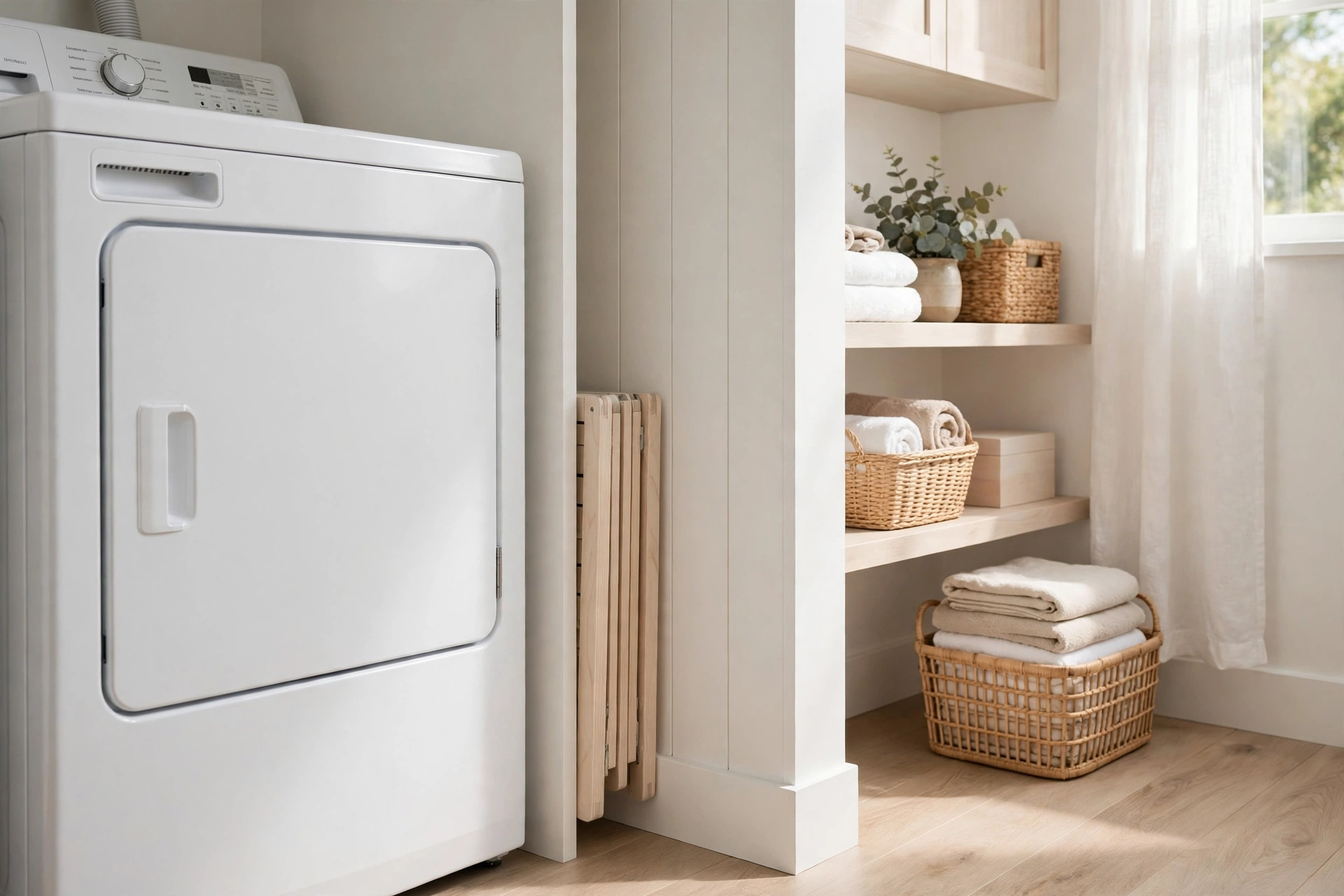
19. Keep a Folding Step Stool in a Slot
A room that stores things up to the ceiling needs a safe way to reach them — otherwise the top shelves become a museum. A flat-folding step stool slips into a five-centimetre slot beside a machine or behind the door, then opens in seconds when you need the high shelf. It’s the small accessory that makes all the vertical storage in this list actually usable.
Tip: Check the stool’s folded thickness before buying — the slimmest models fold down to under 5 cm.
Tips for Getting More From a Small Laundry Room
- Measure everything twice — in a small room, a shelf or cart that’s 2 cm too deep simply doesn’t fit, so keep your key dimensions noted on your phone.
- Keep the floor completely clear: everything stored on walls, doors or machines makes the room feel bigger and quicker to clean.
- Decant detergents into matching, clearly labelled bottles — uniform containers stack tighter and look calmer than a crowd of brands.
- Run one load end to end — wash, dry, fold, put away — instead of letting baskets of laundry live in the room between stages.
- Reset the room every few months: small spaces drift back to clutter faster than big ones, and ten minutes restores the system.
Frequently Asked Questions
How do I fit a washer and dryer into a really small laundry room?
Start with a stacked front-load pair — it uses the floor space of one machine instead of two, which is how most laundry closets work. If stacking isn’t possible, look at compact or slim-depth models, and remember a dryer can sometimes sit under a counter run instead. Measure the doorways the machines must pass through, not just the room itself.
What should I store on the highest shelves in a small laundry room?
Anything light, bulky and rarely used: bulk refill bottles, spare linens and seasonal items. Heavy things belong between knee and shoulder height, both for safety and because a small room gives you no space to wrestle a heavy box down from above your head.
How can I dry clothes in a small laundry room with no floor space?
Go to the walls and the air: a fold-down wall rack, a retractable clothesline across the room, or a hanging rail under a shelf all dry a full load without touching the floor. A small wall-mounted fan speeds things up and stops the room feeling damp.
Which colours make a small laundry room look bigger?
Light, warm neutrals — white, cream, pale stone — on walls, ceiling and shelves make surfaces recede and bounce light around. A satin or semi-gloss finish adds extra reflection, and keeping machines and baskets in the same light family stops anything from visually chopping the room up.
Wrap Up
A small laundry room will never be spacious, but it can absolutely be sufficient — stacked machines, shelves that climb to the ceiling, drying that folds away and a door that stops eating floor space add up to a room that handles the family laundry without the daily squeeze. Start with the one idea that solves your worst bottleneck, and let the room grow from there.